Oct 4, 2026 · @Dave Krikac
Your child finally clicks with a therapist. Then, a few weeks later, you hear she is leaving. Someone new starts on Monday.
Or maybe you’re still on a waitlist. You called in the spring. It’s fall now.
If this is you, you are not doing anything wrong. ABA therapy across the country is going through a hard stretch right now. Therapists are leaving. Some clinics are closing. Some are no longer taking Medicaid.
I’m Dave Krikac. My wife Sandy and I raised our daughter Sara, who has autism. We know what it feels like to search for help that should be easy to find. So we dug into what is really happening with ABA, and we wrote it down in plain words. Here is what you need to know, and what you can do about it.
Why therapists keep leaving
The person who works with your child day to day is usually called an RBT. That stands for Registered Behavior Technician. A BCBA, or Board Certified Behavior Analyst, writes the plan and checks on the RBT.
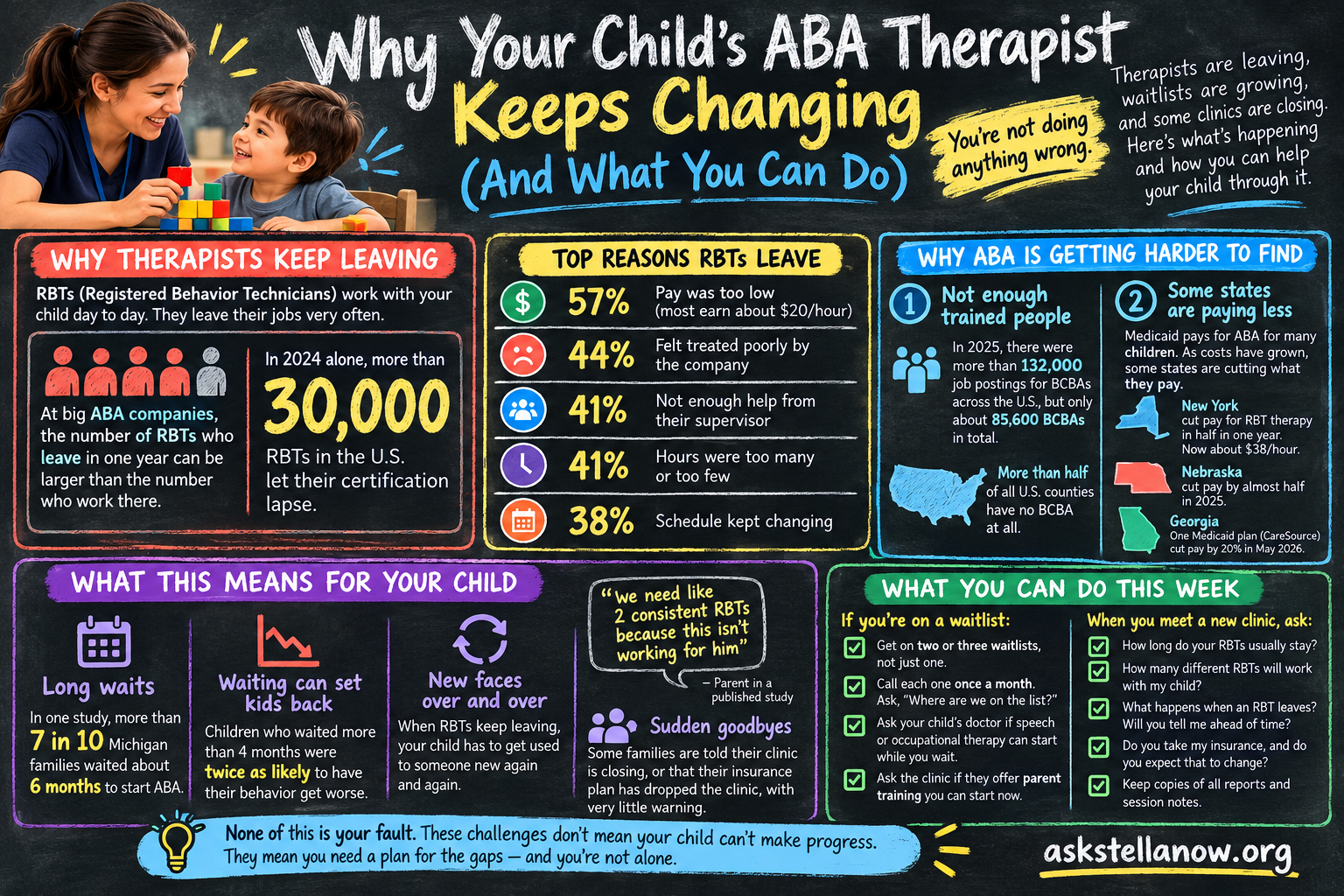
RBTs leave their jobs very often. At big ABA companies, the number of RBTs who leave in one year can be larger than the number who work there. That means some companies replace their whole front-line team in about a year.
In 2024 alone, more than 30,000 RBTs in the U.S. let their certification lapse. The group that certifies them asked why they left. Here are the top answers:
• The pay was too low. 57% said this. Most RBTs earn about $20 an hour.
• They felt treated poorly by the company. 44%
• They didn’t get enough help from their supervisor. 41%
• Their hours were too many or too few. 41%
• Their schedule kept changing. 38%
Here is the short version: many RBTs like the work, but the job is hard to live on. More than half of those who left said they liked the work and life took them another way. About a third said their pay was hard to predict. So good people often can’t afford to stay.
Why ABA is getting harder to find
There are two big reasons. There aren’t enough trained people, and some states are paying clinics less.
Not enough trained people. In 2025, there were more than 132,000 job postings for BCBAs across the country. There are only about 85,600 BCBAs in total, so clinics are all trying to hire from the same small group. More than half of all U.S. counties have no BCBA at all.
Some states are paying less. Medicaid pays for ABA for many children. ABA costs have grown fast, so some states are cutting what they pay. For example:
• New York cut its pay for RBT therapy in half in one year. It is now about $38 an hour.
• Nebraska cut its pay for RBT therapy by almost half in 2025.
• Georgia: one Medicaid plan, CareSource, cut what it pays by 20% in May 2026.
When pay drops, some clinics stop taking new Medicaid patients. Others close. Here are a few real examples from the past year:
• A large ABA company in New York stopped taking new Medicaid patients after a pay cut. It served 523 children there.
• A therapy company in Illinois closed its ABA services and told families by email. Some parents had trouble getting their child’s records.
• A large company left Arkansas and closed its centers in Bentonville, Hot Springs, and Little Rock.
The hard truth is that families on Medicaid often feel these changes first.
What this means for your child
Long waits. In one study of Michigan families, more than 7 in 10 waited about six months to start ABA.
Waiting can set kids back. In that same study, children who waited more than four months were twice as likely to have their behavior get worse. Parents said their children lost ground in:
• Talking and communicating: 82%
• Social skills: 68%
• Everyday skills like dressing or eating: 59%
New faces, over and over. When RBTs keep leaving, your child has to get used to someone new again and again. In one study, a parent put it simply: “we need like 2 consistent RBTs because this isn’t working for him”. That is a real quote from a published study.
Sudden goodbyes. Some families have been told their clinic is closing, or that their insurance plan has dropped the clinic, with very little warning.
None of this is your fault. And none of it means your child can’t make progress. It means you need a plan for the gaps.
What you can do this week
You can’t fix the whole system. You can protect your child from the worst of it. Pick one or two of these to start.
If you’re on a waitlist:
• ☐ Get on two or three waitlists, not just one.
• ☐ Call each one once a month. Ask, “Where are we on the list?”
• ☐ Ask your child’s doctor if speech or occupational therapy can start while you wait.
• ☐ Ask the clinic if they offer parent training you can start now.
When you meet a new clinic, ask:
• ☐ “How long do your RBTs usually stay?”
• ☐ “How many different RBTs will work with my child?”
• ☐ “What happens when an RBT leaves? Will you tell me ahead of time?”
• ☐ “Do you take my insurance, and do you expect that to change?”
Protect yourself in case your clinic closes:
• ☐ Ask for a copy of your child’s treatment plan and progress notes. Do this every six months.
• ☐ Keep a folder, paper or on your phone, with your insurance info, approval letters, and the plan.
• ☐ If you hear the clinic may close, call your insurance plan the same day and ask who else is in network.
One small step this week is enough. You don’t have to do it all today.
If you live in Tennessee
There is some good news. We did not find any TennCare cut to ABA pay like the ones in New York, Nebraska, or Georgia. TennCare covers ABA for children under 21 when it is medically needed. You need approval from your plan before therapy starts.
But Tennessee is still stretched thin. Job postings for BCBAs in Tennessee went up 39% in one year. The state has about 1,400 BCBAs for the whole state. Families in small towns and rural counties may have the hardest time finding care.
If you have TennCare, your plan is one of these: BlueCare, Wellpoint, UnitedHealthcare Community Plan, or TennCare Select. The phone number is on the back of your card. Call and ask for a list of ABA providers in your area.
How Stella can help
Sandy and I were frustrated by how long it took to find help that was out there the whole time. That’s why we built Stella.
Stella is a free helper you can talk to any time, day or night. Ask it things like:
• “Which ABA providers near me take BlueCare?”
• “What can I do at home while we wait for ABA?”
• “My clinic is closing. What do I do first?”
Stella won’t replace your child’s team. Its job is to point you to the right people faster. Try it at askstellanow.org.
You are not alone in this. The system is hard. You are doing a good job.
Like to listen? Here is the accompanying Podcast: https://open.spotify.com/episode/0GtFjl9Md29BmseR2iCBCY?si=tNiwgMCsRfaZWGWfdjtkkg
Rather WATCH: https://youtu.be/uYUmm0_KMMU?si=MvziNi5JhGLqXZxO
Sources
The facts and numbers in this post come from these sources.
• BACB Newsletter, December 2025: why RBTs leave
• BACB and Lightcast: job demand for behavior analysts, 2010 to 2025
• Breaking News ABA: RBT turnover rates
• Breaking News ABA: RBT pay and the BACB survey
• Breaking News ABA: Half of U.S. counties have no BCBA
• Breaking News ABA: States cutting ABA Medicaid pay
• Breaking News ABA: Providers leaving Medicaid
• Breaking News ABA: Illinois clinic closure
• Acuity: New York Medicaid ABA pay cut
• Acuity: CareSource Georgia pay cut
• Public Health Post: how waiting for therapy harms children, based on Stephens et al., Behavior Analysis in Practice (2025)
• Ferretti et al., Children (2025): parents and home-based ABA