The Federal Government Just Stepped Back From Olmstead. Here Is What Actually Changed.
Dave Krikac | The G.E.A.R. Foundation | Originally published July 8, 2026 | Updated November 2026
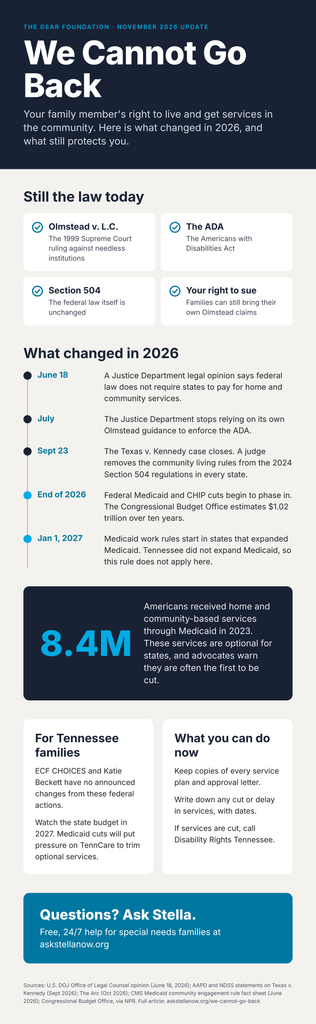
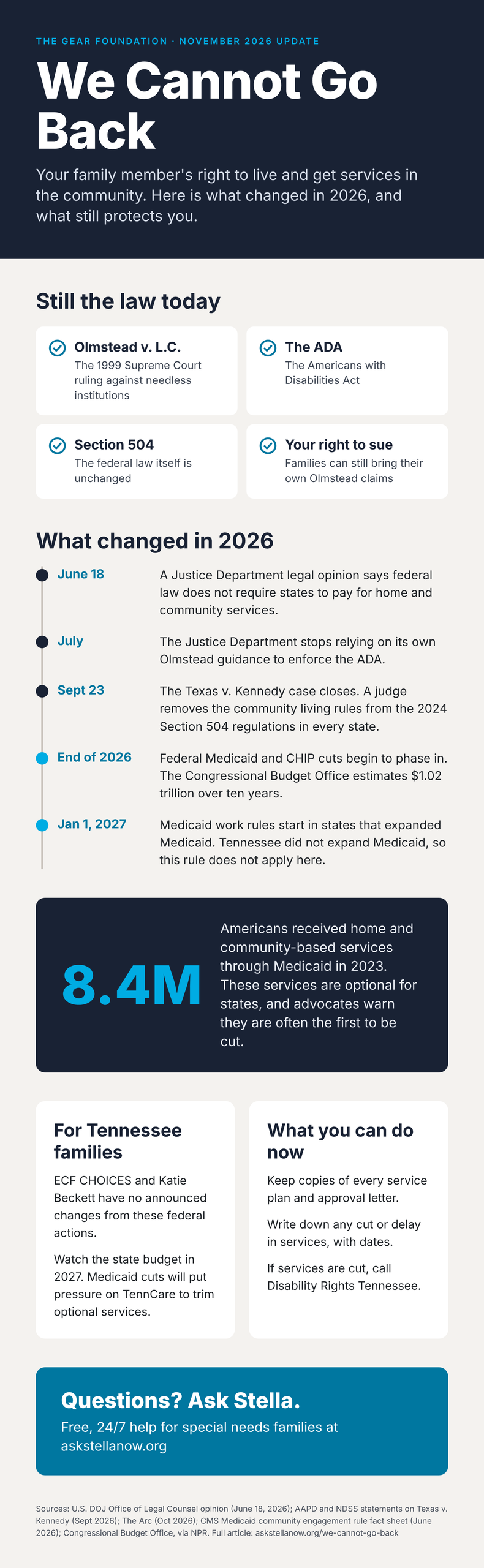
| NOVEMBER 2026 UPDATEA lot has happened since we first published this post in July. Here is what you need to know.The federal government stepped back further. In July, the Justice Department said it will no longer rely on its own Olmstead guidance when it enforces the ADA.A court case closed on September 23. In Texas v. Kennedy, a federal judge removed the community living rules from the 2024 Section 504 regulations. This change applies in every state, including Tennessee.Your rights are still the law. Olmstead, the ADA, and Section 504 all remain in place. The court did not find the right to community living invalid. You can still bring your own Olmstead claim in court.What the January 2027 Medicaid changes mean for Tennessee. You may see news about new Medicaid work rules starting January 1, 2027. These rules apply to states that expanded Medicaid. Tennessee did not expand Medicaid, so this rule does not apply to TennCare members here.What to watch next. The federal Medicaid cuts described below begin phasing in now. Home and community-based services are optional for states, so keep an eye on the Tennessee budget in 2027. Keep copies of your service plans, write down any cut or delay with dates, and reach out to Disability Rights Tennessee if your services are reduced.Questions about ECF CHOICES or Katie Beckett? Ask Stella anytime at askstellanow.org. |
On June 18, 2026, the U.S. Department of Justice’s Office of Legal Counsel issued a legal opinion arguing that federal disability law does not require states to provide home and community-based services to people with disabilities, even when those services are appropriate. The opinion targets Olmstead v. L.C., the 1999 Supreme Court decision that has anchored the right to community living for people with disabilities for more than 25 years.
Families are asking what this means for them. The clearest answer is this: Olmstead is still the law. What changed is the federal government’s willingness to defend it.
What Olmstead actually decided
Olmstead v. L.C. began with two women in Georgia, Lois Curtis and Elaine Wilson, who had intellectual disabilities and mental illness. Both were voluntarily admitted to a state psychiatric hospital. Their own treatment professionals determined they were ready to move to a community-based program. The state kept them institutionalized anyway, in Wilson’s case for years past the point her doctors said she was ready to leave.
Curtis and Wilson sued, arguing that unnecessary institutionalization violated the Americans with Disabilities Act. On June 22, 1999, the Supreme Court agreed. Justice Ruth Bader Ginsburg wrote the majority opinion, holding that unjustified segregation of people with disabilities is discrimination under the ADA. States must provide community-based services when the state’s own professionals agree it is appropriate, the individual does not oppose it, and the placement can be reasonably accommodated.
That ruling became known as the integration mandate, and it has shaped 25 years of policy. It has been used to challenge unnecessary nursing home placements, expand supported employment, and build out state Home and Community-Based Services, known as HCBS. By 2023, roughly 8.4 million Americans were receiving HCBS through Medicaid.
What the new DOJ memo says, and does not say
The June 2026 memo argues that Olmstead only prohibits institutionalizing someone without adequate justification, and that federal disability law does not, on its own, require states to fund community-based services. The memo is candid about how far this departs from settled practice. As quoted directly by NPR, the memo itself states:
“We recognize that this view of Olmstead’s import is out of step with the common understanding of that decision within the federal courts.”
Every legal and advocacy source reviewed for this piece agrees on the same boundary. The memo is a legal opinion from one office inside the executive branch. It is not a law, a regulation, or a court ruling. It does not overturn Olmstead, does not bind federal courts, and does not repeal the ADA or Section 504. Individuals retain the right to bring their own Olmstead claims in court regardless of what position DOJ takes.
Its practical effect runs through influence rather than immediate legal force. DOJ lawyers use these opinions to decide which cases to bring or defend. States facing lawsuits over institutionalization now have a federal memo to point to in their defense. DOJ appears likely to step back from its historic role enforcing Olmstead, shifting more of that burden onto individuals, protection and advocacy organizations, and state-level advocates.
Why this is happening now
The memo is one piece of a pattern that has developed over roughly twelve months. In July 2025, President Trump signed an executive order directing federal support toward involuntary civil commitment and long-term institutional settings as a response to homelessness. Since January 2026, a group of six states led by Texas has pursued a lawsuit, Texas v. Kennedy, seeking to strike down the federal rule that codifies the integration mandate. The June DOJ memo effectively aligns the federal government’s legal position with the plaintiff states in that case. (See the November update above: that case closed on September 23, 2026.)
At the same time, the law signed July 4, 2025, cuts federal Medicaid and CHIP spending by an estimated $1.02 trillion over ten years, according to the nonpartisan Congressional Budget Office, with those cuts beginning to phase in at the end of 2026. Because HCBS is an optional Medicaid benefit rather than a mandatory one, advocates warn it is often the first thing states cut when funding drops. Zoe Gross of the Autistic Self Advocacy Network put it directly: states “will cut HCBS first,” leading to disabled people going without help eating, dressing, using the bathroom, or getting to work.
What the disability community is saying
Disability rights organizations have responded quickly and unanimously. Shira Wakschlag of The Arc called the opinion “a direct threat to decades of progress toward community living for people with disabilities.” Alison Barkoff, a former DOJ and HHS disability policy official now at George Washington University, said it is now the position of the United States government that people with disabilities do not have a right to be part of their communities. Jennifer Mathis of the Bazelon Center described institutional life this way: “For so many people who are institutionalized, their life is literally a hallway.”
What has not changed today
• Olmstead is still binding Supreme Court precedent.
• The ADA and Section 504 are still federal law.
• Existing HCBS waivers and court orders remain in effect.
• Families and individuals can still bring their own Olmstead claims in court.
The federal government’s intent has changed while the law stays in place. It has signaled it may no longer show up in court on the side of families the way it has for the past 25 years.
What this means for Tennessee families
ECF CHOICES and Katie Beckett, the two TennCare programs most relevant to families raising a child or supporting an adult with a disability, have not changed as a result of this memo. Eligibility rules, benefit groups, and application processes are the same today as they were before June 18, 2026.
The risk is indirect. As roughly $1 trillion in federal Medicaid cuts phase in starting at the end of 2026, TennCare will face the same pressure every state Medicaid program faces to protect mandatory services first and trim optional ones, including HCBS, when budgets tighten. For 25 years, a family whose HCBS access was cut in a way that put them at risk of institutionalization had a strong Olmstead claim backed by an assertive DOJ. Today, that family still has the legal claim. What is less certain is whether the federal government will stand behind it.
The right to community living remains. It now depends more on families, self-advocates, and state-level advocacy than it has in a generation.
Sources for the November 2026 update
• The Arc: DOJ Opinion on Olmstead Threatens Community Living
• American Council of the Blind: Final Ruling Issued in Texas v. Kennedy
• AAPD Statement on Ruling Vacating Community Integration Provisions
• NDSS Statement on Texas v. Kennedy
• CMS: Medicaid Community Engagement Requirement Fact Sheet
• OpenMedicaid: Medicaid Work Requirements State Tracker
Infographic