If you are raising a child with special needs, you already know the weight of it. The waitlists. The denials. The meetings where you leave feeling more invisible than when you walked in. That weight is real, and I will never minimize it.
But I also know something else is true. And I think you deserve to hear it plainly, without spin, without fundraising language, and without the kind of hollow optimism that lands like a pat on the head.
Here is what is actually changing for families like yours right now.
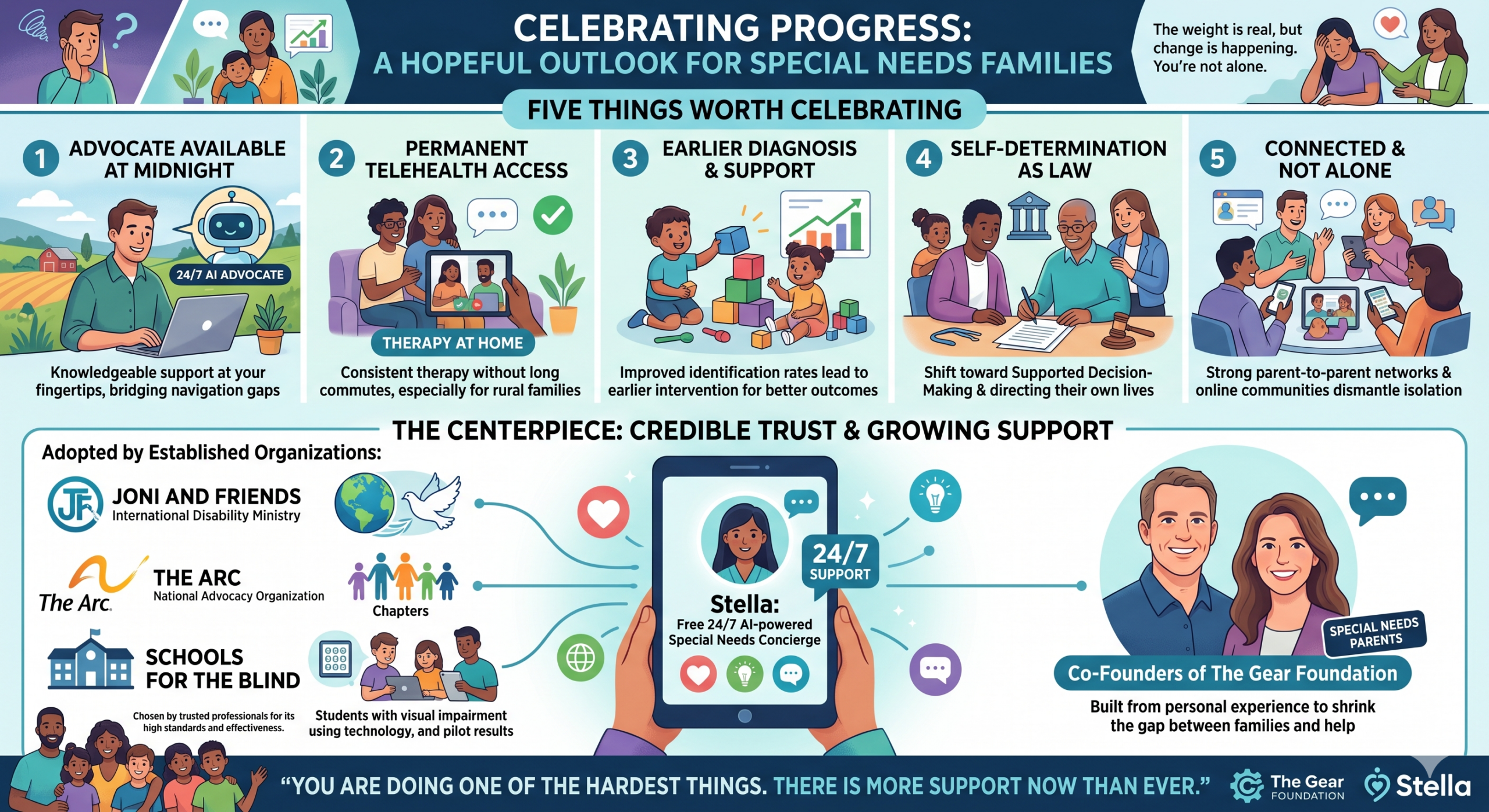
FIVE THINGS WORTH CELEBRATING
1 For the first time, you have a knowledgeable advocate available at midnight.
The gap between the families who know how to navigate the system and the families who do not has always been enormous. That gap is starting to close. AI tools built specifically for special needs families mean that a parent in rural Tennessee now has access to the same quality of information that used to require knowing the right person or paying a consultant. That is a structural shift, not a trend.
2 Telehealth access expanded permanently and it held.
The pandemic forced a telehealth expansion that disproportionately helped rural and underserved special needs families. Many families who previously drove two or three hours for therapy appointments now have consistent access without leaving home. That access did not disappear when the emergency ended.
3 Earlier diagnosis means earlier support.
Identification rates for autism and related diagnoses have improved significantly over the past decade. Earlier diagnosis means earlier intervention, and earlier intervention produces meaningfully better outcomes. More children are getting support at the age when it matters most.
4 Self-determination is becoming law.
The legal and policy shift away from guardianship toward supported decision-making is real and growing. More states are recognizing the right of adults with disabilities to direct their own lives with support rather than having choices made for them. This is a hard-won victory that advocates have fought for for years, and it is landing.
5 You are not alone in the way your parents were.
The isolation that defined earlier generations of special needs parenting has been partially dismantled. Parent-to-parent networks, advocacy coalitions, and online communities now connect families who once felt completely alone. When your child was born, your parents had almost none of this. You have more than they ever did.
THE CENTERPIECE
Now let me tell you the thing that genuinely gave me pause this month, in the best possible way.
Stella, the free 24/7 AI-powered Special Needs Concierge that The Gear Foundation built for families like yours, is being adopted by organizations I deeply respect. Not just individual parents finding it helpful. Established, credentialed organizations that serve some of the most complex cases in the country.
Joni and Friends
One of the most trusted international disability ministry organizations in the world, founded by Joni Eareckson Tada.
The Arc
The largest national advocacy organization for people with intellectual and developmental disabilities, with chapters in every U.S. state.
Schools for the Blind
Two specialized institutions, whose names we will share after pilot results are in, are now using Stella with their students and families.
When organizations like these choose a tool for the families they serve, it means the tool passed a standard that most technology never reaches. That matters to me because it means it is working for you.
I want you to understand what this means beyond the milestone. Joni and Friends does not endorse lightly. The Arc’s local and state chapters work daily with the families navigating the hardest cases. Schools for the Blind are trusting Stella’s voice accessibility with their most vulnerable students.
This is not a startup claiming impact from a press release. This is the professional disability community voting with its trust.
I co-founded The Gear Foundation with my wife Sandy because I am a special needs parent. I know the 2am searches. I know the feeling of walking out of an IEP meeting with more questions than answers. I built Stella because I did not want the next parent to feel as alone as I sometimes felt.
The good news is that the gap between that parent and the help they need is getting smaller. And the people doing the most credible work in disability services are starting to close it alongside us.
You are not behind. You are not failing. You are doing one of the hardest things a person can do, and there is more support surrounding you right now than at any other point in history.
Keep going.
With you in it,
Dave Krikac
President & Co-Founder, The Gear Foundation
Special needs dad